

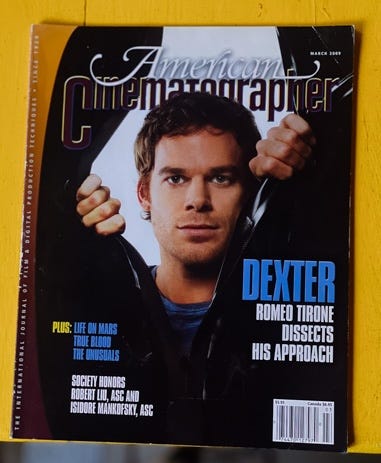
Hello, dear readers of email.
I have returned to give you what everyone has been patiently waiting for, another one of these analysis of old American Cinematographers I keep around like a hoarder and I don’t know why because it’s not like they are collectible items and I think the issues from even 1922 aren’t worth much and I learned that magazines in general don’t really accumulate value over time, even if they are smutty, and are just taking up a lot of space in our Brooklyn apartment.
It’s kind of weird what becomes valuable and what doesn’t overtime. And people collect things that remind them of fun stuff, and reading technical magazines like this one or “Science” magazine probably don’t bring back warm feelings so most people would be fine having these issues thrown out. Which is weird cause people have classic films they are obsessed with, so why not figure out all the juicy gossip on how they made them?
Anyway also why bother writing about them here? Why reread this old tired magazine from March 2009?
Isn’t American Cinematographer no longer relevant? It’s a magazine that’s basically a 50/50 split between “investigative cinema journalism” and advertisements for digital products that are not ever really tools that the world-class DPs featured in each issue would ever think of using. I know a famous DP who passed away once said he thought the magazine was just an advertisement with some articles thrown in.
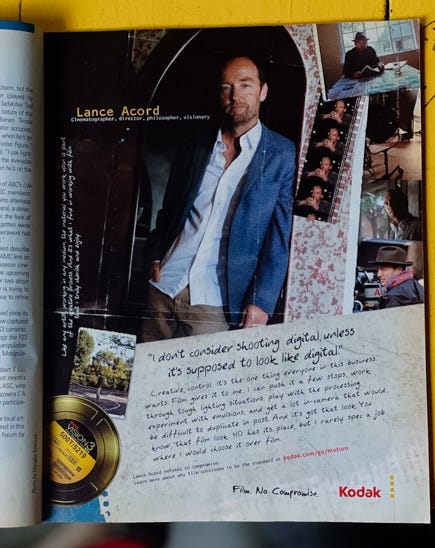
But the ads are amazing and they too hold some value. There’s an amazing ad from Kodak with Lance Accord, my hero, who shot Lost in Translation and Being John Malkovich before he became a director/dp, saying basically that he only shoots film because digital isn’t as good, even though 95 percent of the issue and all ACs (American Cinematographers, not Assistant Camerapeople) are celebrating the transition from film to digital. He doesn’t shoot digital and try to make it look like film because it doesn’t work and he’s still 100% right.
And kind of Lance of 2009 was right, even though he transitioned to video - film is still thriving in 2026 even though its more stressful to shoot with, especially since you can ruin a day of shooting, because you still just can’t match the color even if you go with a digital to film out.
But really why am I doing this substack? It’s funny cause I read so many substacks and I assume it’s a simple process for the writer, but it’s actually taking me hours and also I’m supposed to stick to the facts and I can’t do that and its taking me hours and its actually enjoyable to write again since I don’t really but it does take up a good amount of time, but then again thats time I would waste on the internet rotting away so why not spend it having fun?
But I’m not going to fluff stuff out too cause I don’t know why I am doing this. The magazine industry is dying, but after reading this issue, I am sad about it. I’m conflicted? Should we just let the ghost die and move on? It seems people rather listen to a podcast with the famous DP of a film sponsored by aputure lighting, or youtube videos secretly getting 20 percent or not secretly getting commissions and tacit agreements that they go easy on products or they lose early access and all that crap than pay $50/year to get a magazine dumped off in their mail slot.
And it’s a sadness to me cause I love magazines of all kinds and long-form journalism and just kind of all kind of essays about anything, articles over 3000 words - deep dives as we now call them. And I think in like 15 years there really won’t be much of that because if this was my job, I wouldn’t make any money doing it as its all a smaller and smaller industry.
As proof, the modern American cinematographers have probably 80 less pages of content.
And its sad cause it’s a different experience than reading smaller articles online. And especially with cinematography. There’s a different experience that comes from reading a sentence and then in ones head having to think about it just from looking at a few frames from the film in the magazine, having to guess what they mean and what they invented, and a sense of curiosity that comes from that experience with no visual clues beyond 2 photos a page.
Finally who cares so lets get on with the show.
Gomorrah, d.p. Matteo Garrone
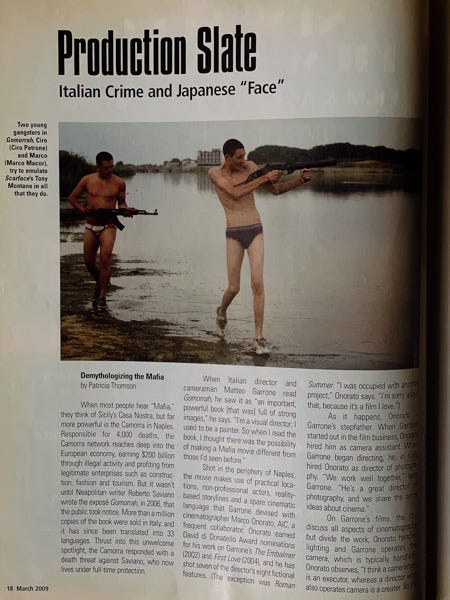
If you haven’t seen this film, you need to. How do I know? I don’t. I just remember hearing other people say that, so I’m going to say that. This was the weakest article out of all of them. The DP Matteo Garrone says stuff like “we didn’t want to show off with our frames or the camera movement.”
But don’t you kind of want to do that? For me I follow the work of Chris Doyle who says that camera movement makes a frame three dimensional. And what is a show-off frame vs non-show off frame? I feel like if you go sloppy or fake with lighting, that’s show off but in the way Matteo doesn’t think it is, cause it takes you out of it all. Like is a good frame show off like in Ratcatcher the slow dolly in a frame within a frame? No a creative frame I think is really nice, or a creative use of lighting. It makes no sense to me but why obsess on this? Like films shot so well I love and I don’t get out of the picture, whether on sticks locked off, or with tons of stylized dolly and crane movement. I don’t care either way.
FACT! They shot Gomorrah on Zeiss Ultra Primes and avoided zoom lenses. Which is interesting cause mixing Vision3 500t with Ultra Primes or Master Primes, which are fairly “modern” lenses seemed to be a big trend back then, where it mixes the beautiful flaws that film gives naturally- the halation, the blooming, vignetting, and color. And this is just the inverse nowadays where we we mix “flawed” lenses with a “modern” sensor, adding diffusion and grain in post. At the end of the day, today without shooting film, this is the way. And interestingly enough, a lot of people who still shoot film today use “modern”ish glass, so they continue this tradition.
FACT: The lenses they used were the 20mm, 32mm, and 40mm. That seems to happen a lot! Always got to be different like hipstery by not going with the standard 18, 35, and 50mm? Or… then again they are simulating using full frame, cause when you shoot at a 25, 35, and 50mm in full frame you kind of get there in that it’s 30 percent wider or something. (EDIT: a 85mm full frame is like a 65mm, a 50mm full frame is like a 38mm super35, a 35mm full frame is like a 27mm, and a 25mm full frame is like a 19mm, so even back in the super 35mm land, DPs liked that full frame focal length!) Interesting, right? See what you can learn from old issues of American Cinematographer?
Tokyo Sonata, d.p. Akiko Ashizawa, JSC
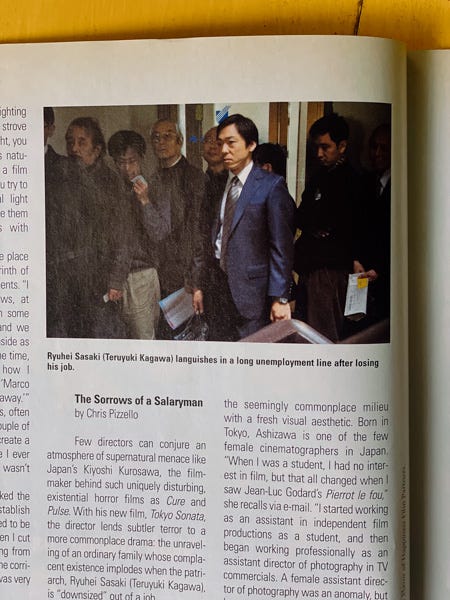
Some Japan horror movie. I skimmed this one. As I skimmed I noticed they have a position called the assistant director of photography - is that they same as an assistant cameraperson? Or is it the assistant to the DP like they joke about in the UK Office? Do they get them coffee and tell them how great each shot is, or do they get them in focus and make sure the camera department is being run efficently so the DP can concentrate on the bigger issues? If it’s the later, that term should come back because it’s more important sounding for the AC.
FACT. They used the arri 535 camera which is very heavy like I think like 20-30 lbs so you don’t want to do much with it, and pray that when you found your frame it’s okay cause no one wants to move a camera with probably fully built is 40 lbs or so. And that sucks. Or it means the DP didn’t value the life of their assistant director of photography.
Fact: In Japan they use a cinematographer and a lighting designer and they both are equal. It’s not a chain of command and I really like that. That seems like a richer, more healthier relationship and less ego-driven. The DP is tied with the gaffer. They can fight and argue and no one gets the priority. They have to compromise and respect each other.
Fact: They lit the dining room at night with 3200 kelvin lamps and cyan florescents in the back. Not just daylight! I like cyan and I like they did this back in the age of kino flos not LEDs. And at night they also used store both tungsten florescent eco lights which gave texture - not perfect lighting. And they would put a green tinted light outside for a night exterior.
Fact: They also put a partition in front of a 10k on a upstairs landing area and called it a “seaweed” effect - is that like a cuckoloris? They never explained it so we all need to use our imagination.
Now onto the bulk of the issues - TV stuff, the MEGA article of the month! (Like the playboy centerfold!!!)
DEXTER, d.p. Romeo Tirone
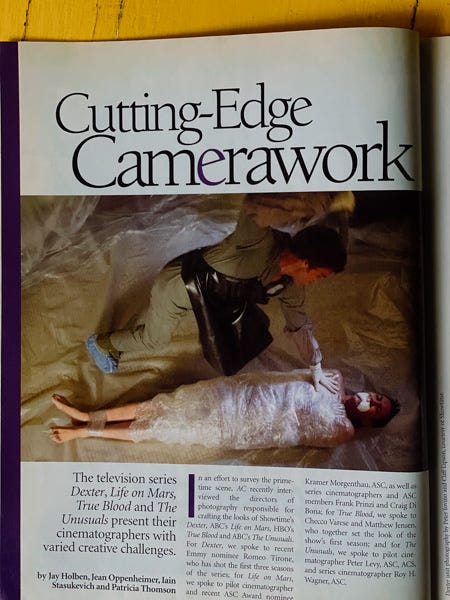
Dexter is a show I never saw, and I like that actor guy from six feet under, Michael Ian Black or something? I don’t know why I missed this show or care to look up his name, but I missed a lot of shows back then on showtime or hbo cause I didn’t have it.
FACT: Dexter was shot digitally - on the sony f900 I think then later the sony f23, which they shot Avatar on. This is kind of the dawn of serious tv shows and movies being shot digitally, years before the alexa came in and took over (as well as the red camera). The F23 was like a f35 I think, which was Sony respecting cinema color, and it was on a CCD sensor, not the CMOS sensors everyone uses today - no subsampling of color! Less dynamic range and definitely nothing in the shadows so not as good in low light, just like film. It’s tough to light but the color is more interesting.
They used the f23 with the sony ex1 as a crash cam which I owned and this kind of was the start of large shows using smaller prosumer cameras where they needed it, elevating these small cameras as a useful tools, and definitely cat nip to American Cinematographer- they can sell these puppies to the masses and make it seem like once you get one, you too can shoot a show like Dexter!Now that I remember it, the big breathru was on “Black Swan” they used a canon 7d on the subway scenes and at the time I couldn’t tell with the film out.
Fact: they shot the first two season exteriors with a straw filter - I wanna try! Is that the CSI Miami and Spring Breakers look? I WANNA TRY!
True Blood, d.p. Checco Varese, AMC


What’s cool on this is what they invented for the show. The gaffer Evans Brown seemed like one of those inventor types fellas that I love. He created the “triffids” which was a home-made softbox. He would put 750 watt nook lights and build an casing and sprayed black on the inside and white outside and he used 1000h gel as the gel. He put dozens of them in the ceilings to really control the light source overhead. Interesting to do this instead of one giant soft box above. I like when someone just invents something. Why not? They used to do that all the time in medical surgery!
He also would put kino flos in pvc pipe housing to control how much to use, if he wanted to make like a custom length kino.
The DP surprisedly was ok with white walls in the kitchen sets cause he would bounce light from outside and it would blast around the room really nicely. So white isn’t always the enemy of good, and as a DP you don’t always need to whine about white walls unless its a night scene where it makes creating contrast really darn hard.
He made the sun with a 20k tungsten light and 12-light maxibrutes in season one - that a lot of light yikes. And also shows you can mix lights together and still make it feel like one source.
The Unusuals, d.p. Roy Wagner, ASC
The best part of this is it was shot by Roy Wagner who is hilarious on facebook and the CML (cinematographers mailing list) - and he also embraced smaller cameras.
Rest of the Issue
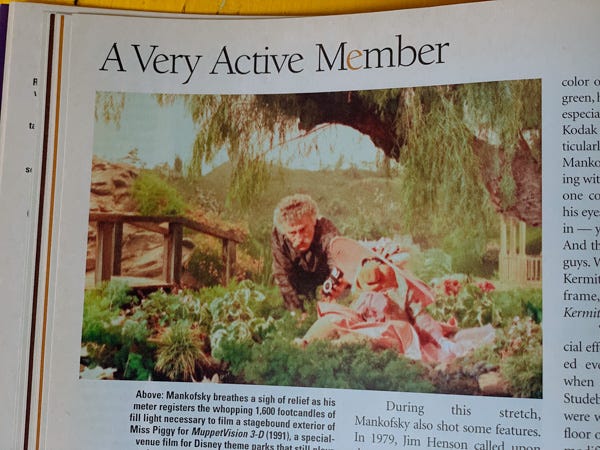
The issue then gets into honoring old timers and I didn’t really feel like reading that stuff.
Actually I’m reading it now and it’s amazing. The DP Mankofsky was featured and he worked with George Lucas on Ewok the battle for Endor (1985) which I need to see asap cause I didn’t know they made a bunch of these weird TV shows featuring those lovable rapscallions. He said this about George Lucas. ”George is a very, very nice man but an impatient director. He’s a lot like me, when something starts to slow down, I’ll go and do it myself.” I’m the same way and I love that at the highest level of hollywood, the director still has to do it himself.
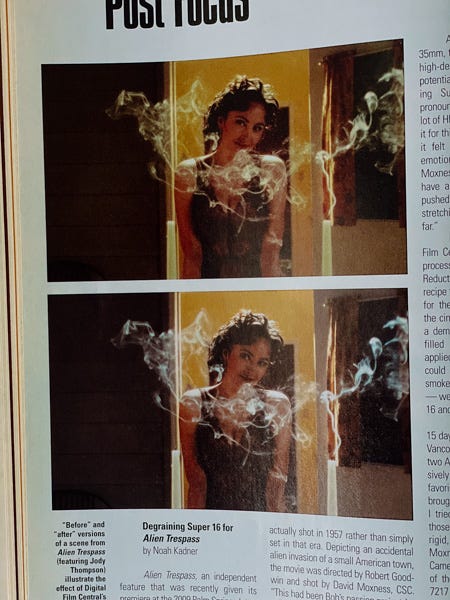
The section called “Post Focus” was cool.
They degrainined super 16 for Alien Trespass and that looks really good it made it look a lot more like 35mm! Why doesn’t everyone just do that?
And that’s all you get. Did you learn anything? I feel like maybe one thing? Was reading this worth your time? Who cares! It was worth mine. I’ll get back on the wagon and do more of these.