
Every DP Hates Nights. Featuring Lance Accord for dir. Spike Jonze, "Where the Wild Things Are"

Where have YOU Been? Where have I been?
As a refresher, one day I was clearing out my old collection of antique women’s hosiery when I found behind a box some old issues of American Cinematographer. I opened one up and I was shocked to learn a fact or two from the old world of 2005-2014. And now that old is new again, this substack has become the most important substack of all time. And to think I left it at the height of my power.
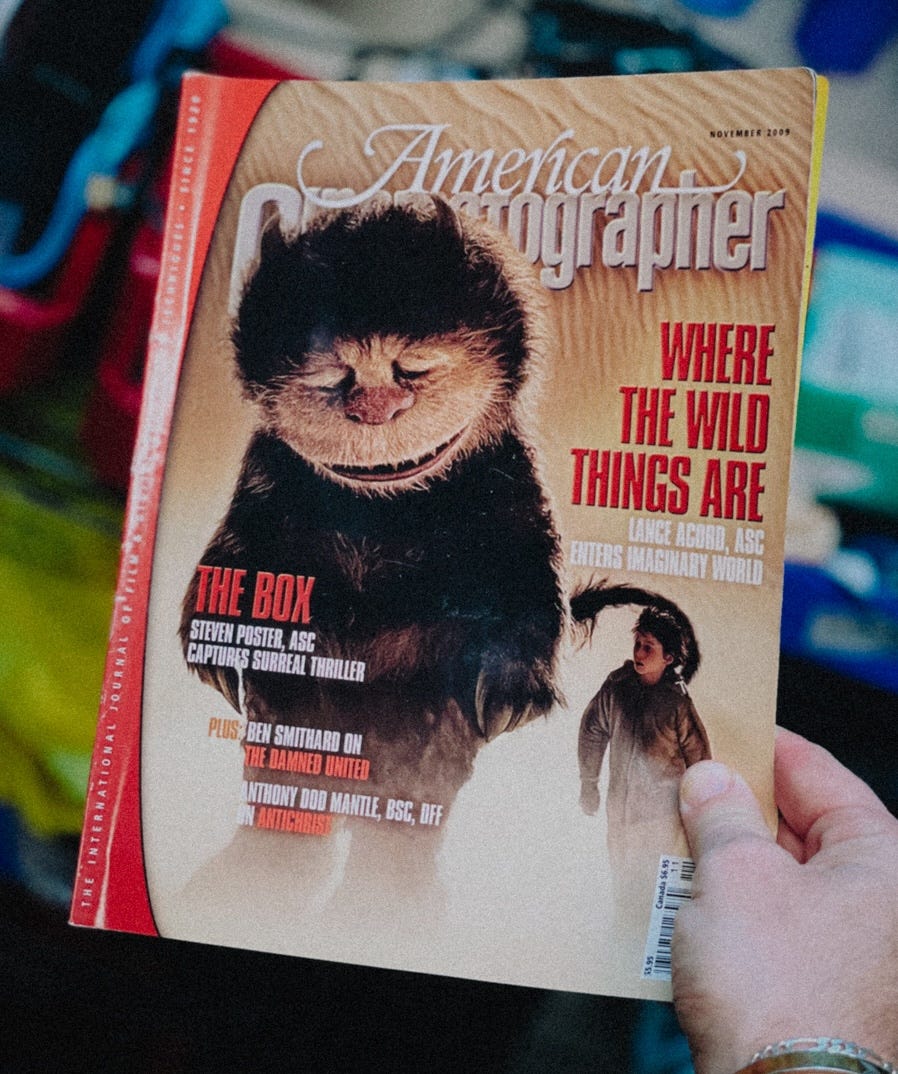
This brings me to November 2009, with an article about “Where the Wild Things Are” directed by Spike Jonze and shot by Lance Accord.
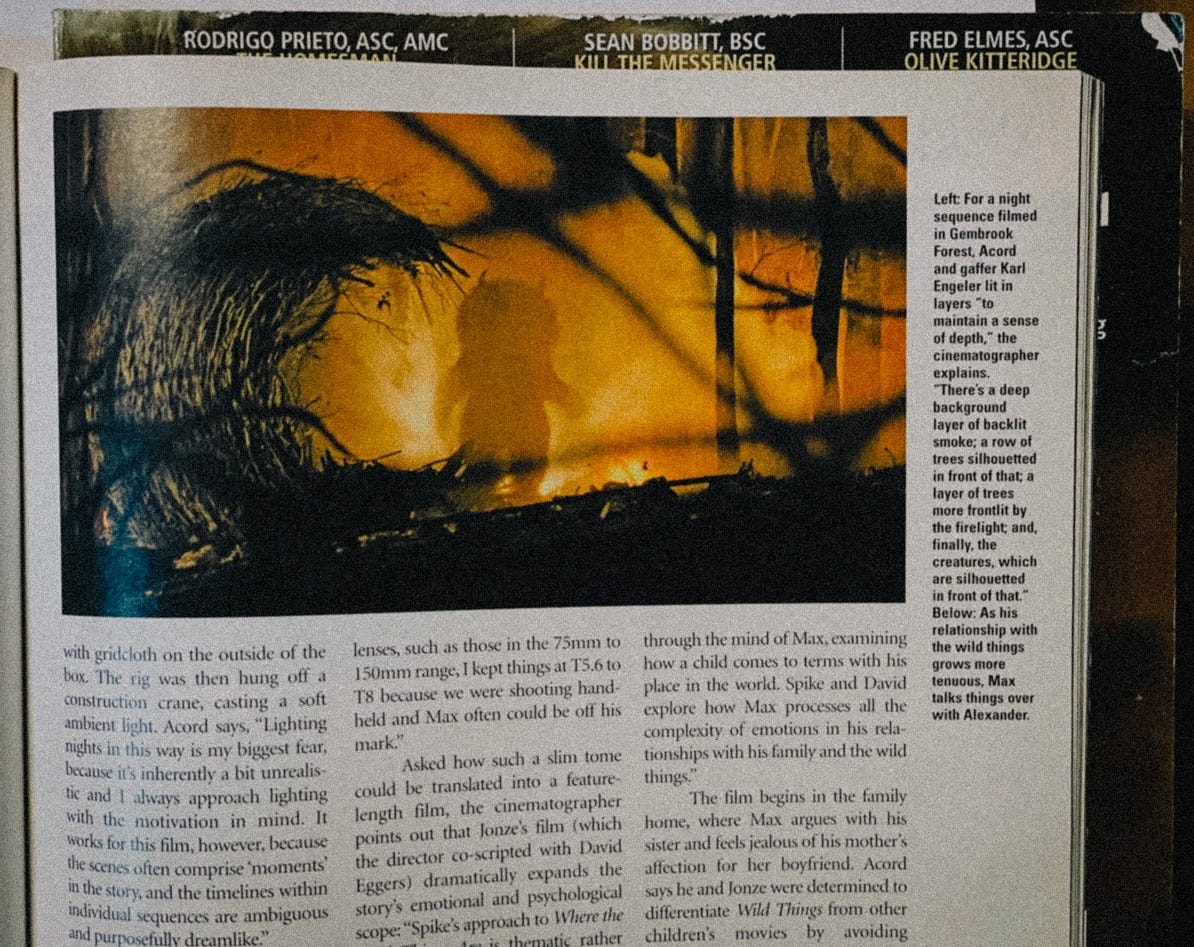
Look how gorgeous it is, how gorgeous Lance’s handheld is, his lighting, his naturalism and lens choices:
This filmmaking team created some of my most cherished films. Being John Malkovich, Adaptation. They all feel completely modern and it’s a sad thing they no longer work together. Who knows why. I know Lance started Park Pictures but filmmaking partnerships definitely end many times.
This article about this film, to be honest, is not a good examination of how gorgeous the film is. It didn’t have that much interesting and salacious details other articles do. Whomever the writer is didn’t really get the artistry of the look and wasn’t super curious how Lance and Spike make it, nevertheless to bring such artistry and energy to a genre that no one expects it: the kids film. I want to track down Lance and ask him more about it.
Lance is a naturalistic DP, so he likes to make stuff look beautiful but how you would find them naturally. And when you bring your camera outside at night, all you see is black. No image! Like having the lens cap on.
So to make a naturalistic movie at night, you can’t! But you can’t give up - you have to bring a sense of naturalism to what is completely unnatural.
So he hates it. It’s hard!!!
As I’m sure everyone does. It’s super easy for this fact to make night look fake and dumb, so in lesser hands this can easily happen. Look at movies from the 80s with like steel blue moonlight and see if you like that.
So for Lance, it was many times a soft moon light overhead rig with a ton of space lights going through grid. A technique that works still to this day.
And then it’s backlight. And that’s how it’s always been.
That’s kind of what night is for everyone, but the difference between Lance with Spike and mere mortals is his artistic sensibility. The nuance of creating something unnatural without overdoing it.
Side thought: this shot was ay for night which I love below:

More diversion:
On lenes, he loved the 27mm focal length. Which is Speilberg’s favorite focal length for a kids perspective as well. UH OH.
And Panavision Primos as some of the best glass ever made.

Lance and Spike backlit stuff with a bunch of 12ks space lights on scaffolding and he added 3/4 CTO to make the light super firelight warm, like what 2500 kelvin. Film really can capture the richness of this color.
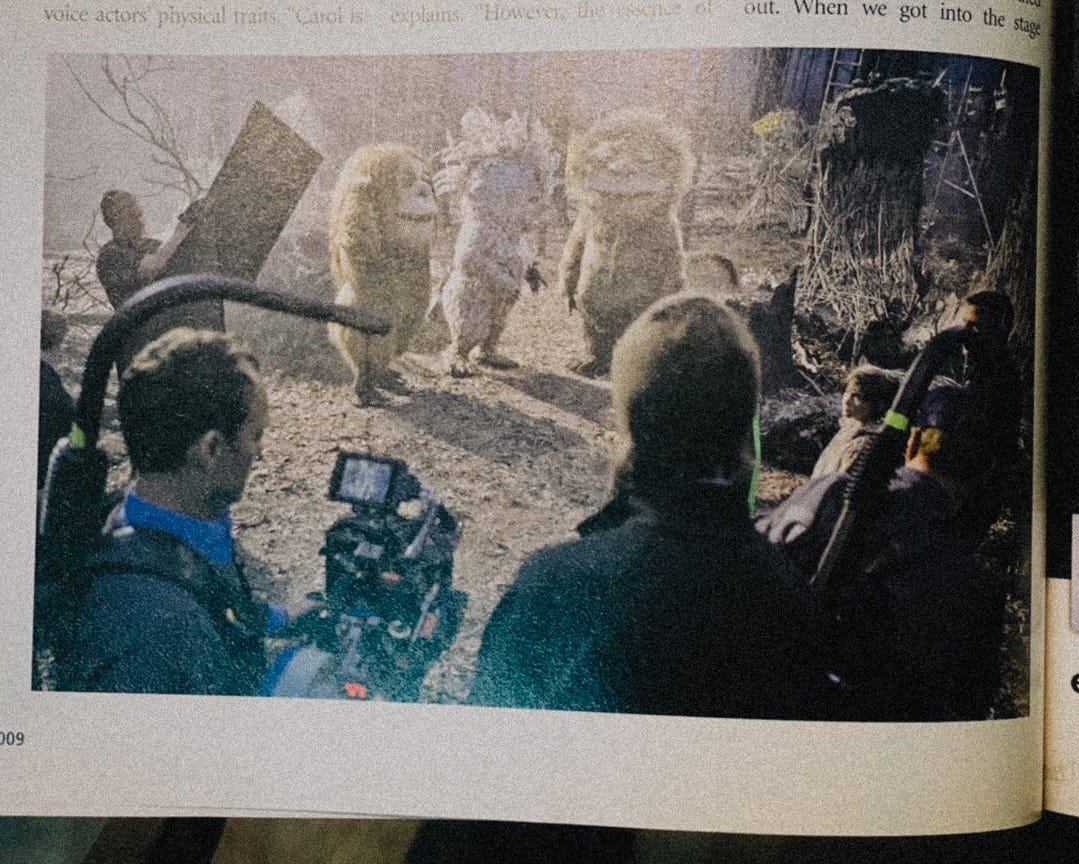
Below here’s the easyrig in action! 2009 baby. I think one of the first times I saw it being used.

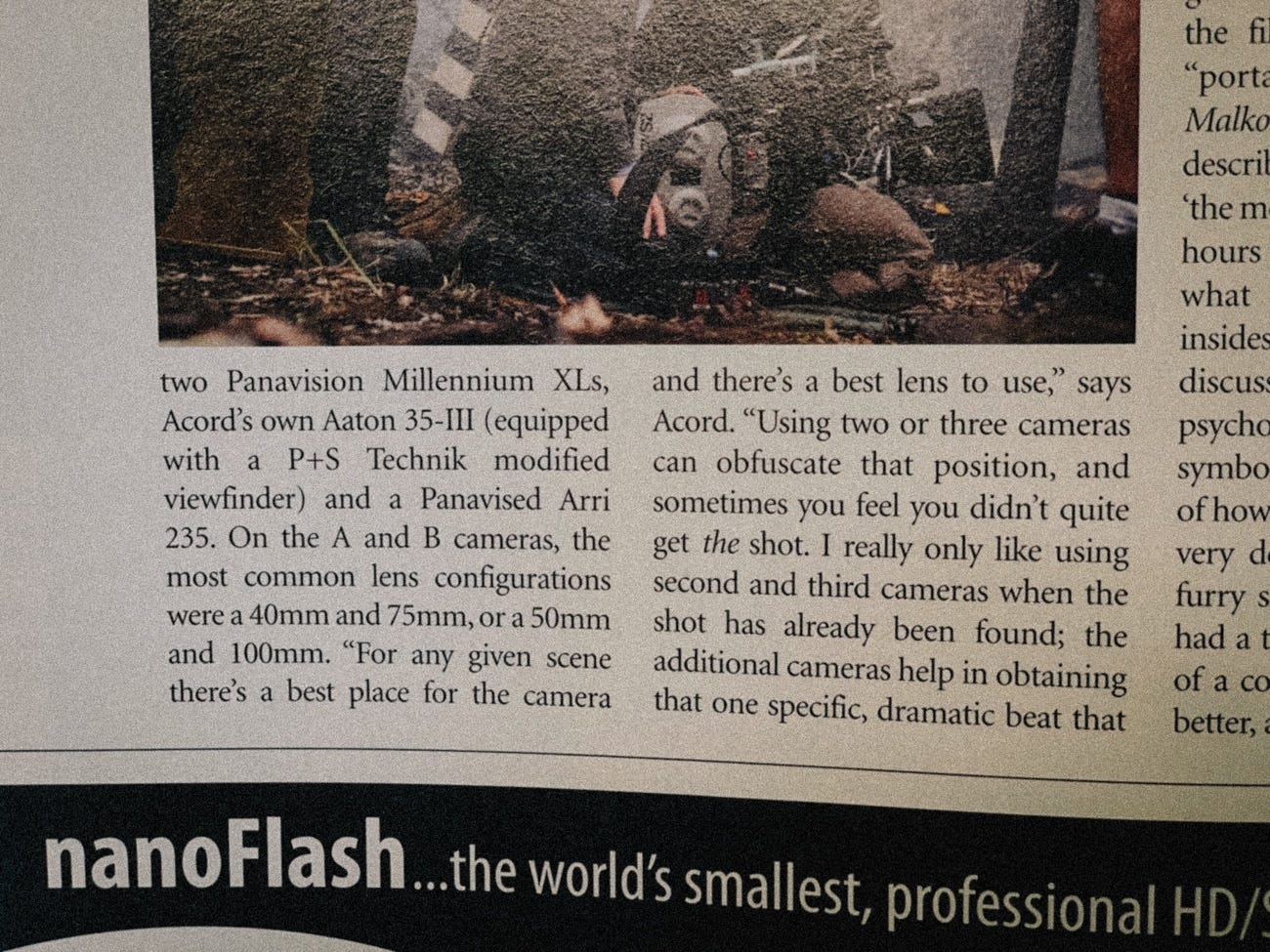
Below he talks about how multi-cam can compromise a look and an angle, so he finds the shot on a camera then has b camera work around it - I like that.
Other useful things:
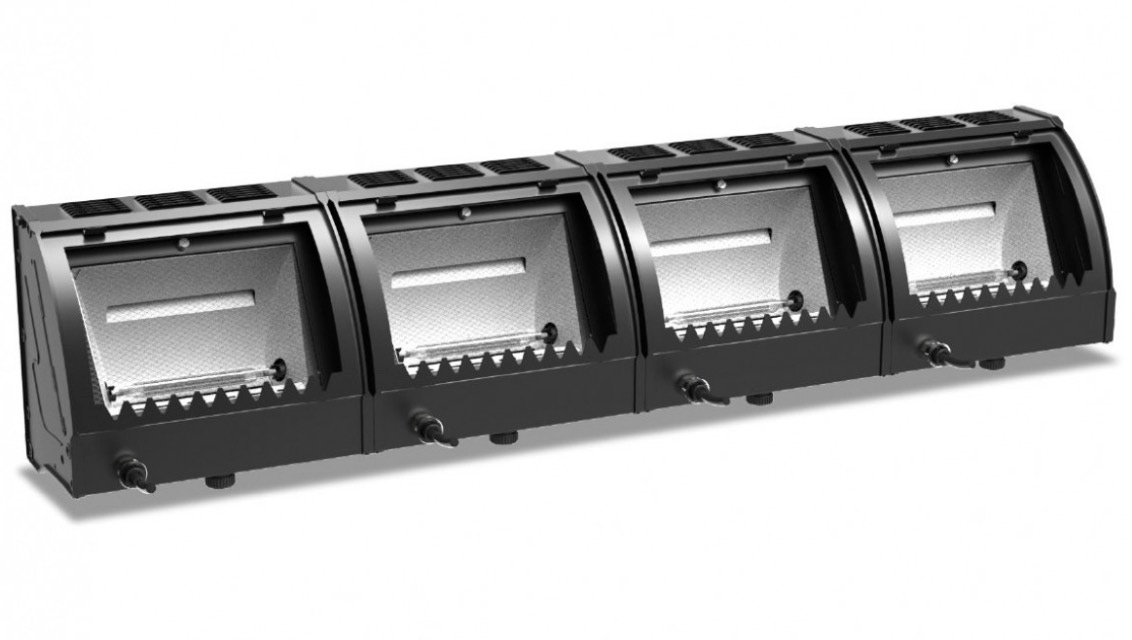
He simulated campfire with flame bars and par cans and ground rows. I didn’t know what a ground row is so I found it - it’s a theatrical light strip, so probably would be using astera titan tubes nowadays but also that could be interesting to have multiple lights vs one long tube.
Lance said he would light night by lighting “layers” of objects which I love.
So he would light the deep background with smoke, then the trees, then the more foreground objects, then the creatures.
This also can be applied to interior spaces - something I noticed Darius Khondji does so well in Marty Supreme.
that is all the lighting depth, further accented by color contrast as well.
They also used an optimo 15-40mm zoom and a panavision 27-68mm zoom which I love because it shows you as a DP you can mix up lenses - you don’t need each lens to be from the same set. Paul Thomas Anderson does this a lot with Zeiss Jena glass and Nikon glass.
This is the cover here, by the way.
There’s more to talk about, and I found another issue of AC that has basically the transition of hollywood to using film with digital and just digital issue with Gone Girl and Nightcrawler and Antichrist which is more interesting than this issue, but I don’t feel like talking about it right now because I’m pretty busy doing other stuff and time to move on.
And why Spike left Lance, or Lance left Spike, using Hoyte Von Hoytemon for “Her” I won’t know. I do know, if Lance shot her, I think the film would have been even stronger. For all that we all love about Hoyte, I don’t feel like Hoyte has the same soul as Lance, the gentle caring soul of how he frames and films and treats the actors in the frames.